This post is part of our Ten Years of the WPHP Spotlight Series, which will run through August 2026. In May 2026, the WPHP held two wrap events to celebrate over a decade of collaborative data creation and research, showcasing some of the projects that have emerged in the process. This series shares these projects along with further reflections from the creators and researchers.
Authored by: Kate Moffatt
Edited by: Kandice Sharren
Submitted on: 08/21/2026
Citation: Moffatt, Kate. "A Blanket Statement: Data Physicalization and Embodying Women's Labour." The Women's Print History Project, 21 August 2026, https://womensprinthistoryproject.com/blog/post/157.
 Kandice Sharren, left, and Kate Moffatt, right. Photo credit: Rebecca Saloustros.
In the last decade, the WPHP has amassed nearly 1500 records about women who ran publishing, printing, and bookselling businesses in the eighteenth and early nineteenth centuries. Roughly 850 of those records are for their businesses: capturing the dates they were active, the addresses and cities they operated out of, and their business partnerships. The other 650 or so records are biographical, with data fields for their full names, their dates of birth and death, and where they were born and where they died. So for every woman who ran a publishing, printing, or bookselling business, we are trying to capture ten specific pieces of business and biographical data* in their Firm and Person records:
their first name,
their last name,
the address of their business,
the city the business was located in,
the year they started operating the business;
the year they finished operating the business;
when they were born,
where they were born,
when they died,
and where they died.
*We are also trying to collect bibliographical data about the books they produced, but that is an ongoing process only partially completed at the time of the WPHP’s official end.
Our ability to find and capture the Firm and Person data for women-run firms in the WPHP can be unpredictable—as a result, the data we have is not complete or comprehensive, and cannot be. As we’ve talked about in other Spotlights, and especially in our Down the Rabbit Hole: Researching Women in the Book Trades Spotlight Series, information about women-run firms is often hidden in records for their male relatives or business partners, or behind genderless initials in imprints; biographical data, in particular, is not forthcoming since it is not captured in imprints in the way information about their businesses can be. There are, in other words, gaps in the data that we have not been able to fill during the last decade.
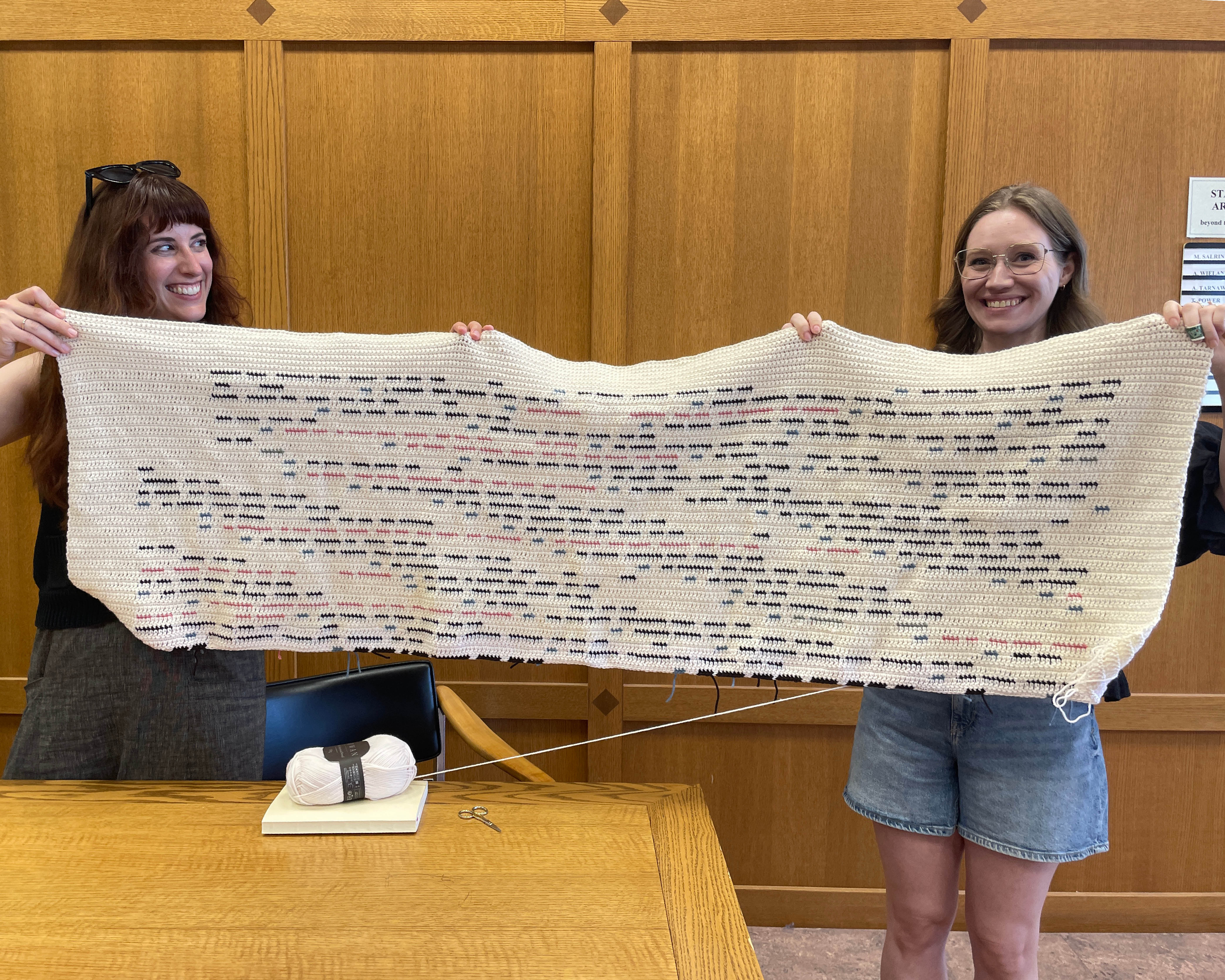
These gaps, and the patterns of what data we have been able to collect or not, are not especially visible in the WPHP. In the spring of 2026, I undertook a creative project using our women-run firms data: crocheting a blanket that displayed all of the business and biographical information we have collected, and also that we have not been able to collect, for women publishers, printers, and booksellers. Inspired by the format of the print books that were the output of their labour, the blanket is styled as a “page” of print. The base of the blanket is a cream, paper-like colour; the default colour for the data is a dark brown, reminiscent of iron gall ink; the dividers between the data entries is a decorative blue; and extreme variations in data—either a lot of it, or very little of it—is indicated in a bold red-pink, inspired by the red shoes worn by the ‘beauty’ in the “Beauty in Search of Knowledge” engraving on the homepage of the WPHP database, or in a sage green, the colour of the books in the windows of that same engraving.
The data is ‘written’ into the blanket ‘page’ letter by letter, and line by line, with a single stitch for every letter or number of their names, addresses, cities, years, and so on, with spaces between the ‘words.’ As an example, see the image below, where the first woman in the blanket is Margaret Adkin. She worked in New Market Place in Beccles, from 1818 to 1823, and she was born in 1783, and died in 1863; we do not know where she was born, or where she died. To represent that missing data, I added a ‘gap’ in the line: blank white stitches where the data would be, in a length approximate to the space the data would have taken up if we had it. Throughout the blanket, a missing year of activity or birth or death is represented by four ‘blank’ stitches; a missing name or place is represented by eight ‘blank’ stitches; and a missing address is represented by twelve ‘blank’ stitches.
The data is ‘written’ using the brown yarn by default, and the majority of our data is displayed this way in the blanket. The pink and the green indicate where we have significantly more or less data than the average record: the women for whom we have almost all of their data (at least 90% of the data fields filled out) are represented in the blanket in pink. The women for whom we have very little data (30% of the fields or less, or if we have only their last name and no biographical information) are represented in the blanket in green.
Ann Vernor, who Research Assistant Belle Eist wrote about in her Spotlight “Hidden in the Imprints: Introducing Ann Vernor, Bookseller and Publisher,” is represented in pink: we have her full name; the street she worked on or area she was located in—the Poultry—and the city, London; the start and end date of her ownership of the business; and her birth year, death year, and place of death (in Islington). There is one gap, which represents the only missing data: her place of birth.
In comparison, our green entries represent women for whom we are missing the majority of identifying data; in this particular example, the short series of green stitches and the gaps surrounding them represent Ann Cole, who worked in London, but for whom we are missing all other identifying data, including her business address and dates of activity, and all biographical details. That she is in the database at all means someone identified her in a resource for the eighteenth and nineteenth centuries, but the lack of any dates or biographical information means tracing further information about her is nearly impossible (if you know more about Ann Cole, we'd love to hear from you). Ann Cole is one of the more extreme examples, but gaps where some or all of the biographical data should be appear throughout the blanket. When we consider how finding biographical information for these women often requires a level of time and original archival research that is prohibitively expensive for a project of the WPHP’s scale, it’s not surprising that this pattern shows up in the blanket.
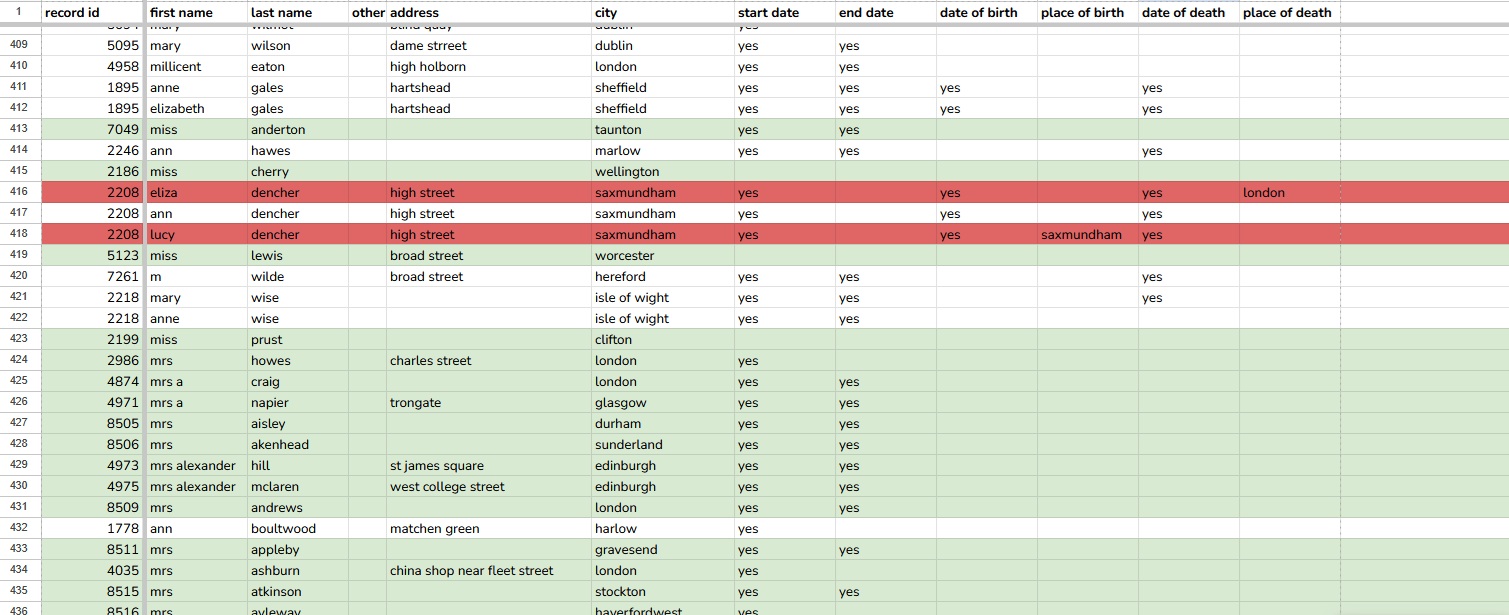 A screenshot of the spreadsheet used to produce the blanket, displaying a section where most of the women are missing all biographical data.
In some ways, we can see this project as a form of data visualization: I have begun making visible how many women we have for whom we have a lot of data, and how many for whom we have little. But in addition to making visible these labouring women in the WPHP, the blanket makes visible our own labour in ways that the many records we have created in the database can only suggest at. The physical size, weight, and design of the blanket, made with my own two hands, represent the hours of labour crocheting and the hours of labour producing records that, much like many books in the eighteenth-century, do not always make obvious their makers. The project falls under the umbrella of ‘data physicalization,’ which, to somewhat oversimplify the term, involves turning data into a physical form as a means of allowing for a different understanding or perception of it. When holding this physical blanket, feeling the wool that makes up the yarn, the texture of the stitches, the weight of its size, I am also ‘holding’ these women, brought together in the blanket. I am holding representations of their labouring selves, in a product of my own labouring hands. While you cannot take this blanket and ‘use’ its data—after all, it uses stitches to indicate letters; there is no way to know which stretch is for which woman unless you have access to my notes for the project—it matters that this is a project I made with my own labouring body, engaging in embodied work to capture women’s embodied labour in the WPHP.
The blanket shown here (and the one still sitting in a project basket, in my living room) is unfinished. In practical terms, it’s unfinished because of time and costs required to produce it: in addition to the cost of labour, the materials themselves are expensive for a project of this scale. But symbolically, the unfinishedness feels completely apt: this kind of work, where we trace women’s labour in the book trades and make attempts to sleuth out details about their lives, will never be “finished.” Much like the WPHP, which continued to grow, and, funding permitting, would be continuing to grow still, this project is inherently unfinished, limited by time, money, and the expansive nature of the work. Nonetheless, even partially produced, we experience affective responses to it. When we pick up an eighteenth-century print book, we don’t necessarily think first about the people involved in making the physical object in our hands; it can be easy for our minds to turn first to a book’s contents, and to think about who wrote the words within it. This project asks us to think not only a bit more about the embodied work of producing something, like a book, or a blanket, but to consider the experience of seeing something explicitly framed by its handmade-ness, and how that affects how we understand or perceive, and maybe how it recenters, the individuals at the heart of its material production.