This post is part of our Ten Years of the WPHP Spotlight Series, which will run through August 2026. In May 2026, the WPHP held two wrap events to celebrate over a decade of collaborative data creation and research, showcasing some of the projects that have emerged in the process. This series shares these projects along with further reflections from the creators and researchers.
Authored by: Michelle Levy, Isabella Eist, and Anna Opryszyko
Edited by: Amanda Law
Submitted on: 08/12/2026
Citation: Levy, Michelle, et al. "Ten Years of the WPHP: Exhibition Catalogue." The Women's Print History Project, 12 August 2026, https://womensprinthistoryproject.com/blog/post/154.
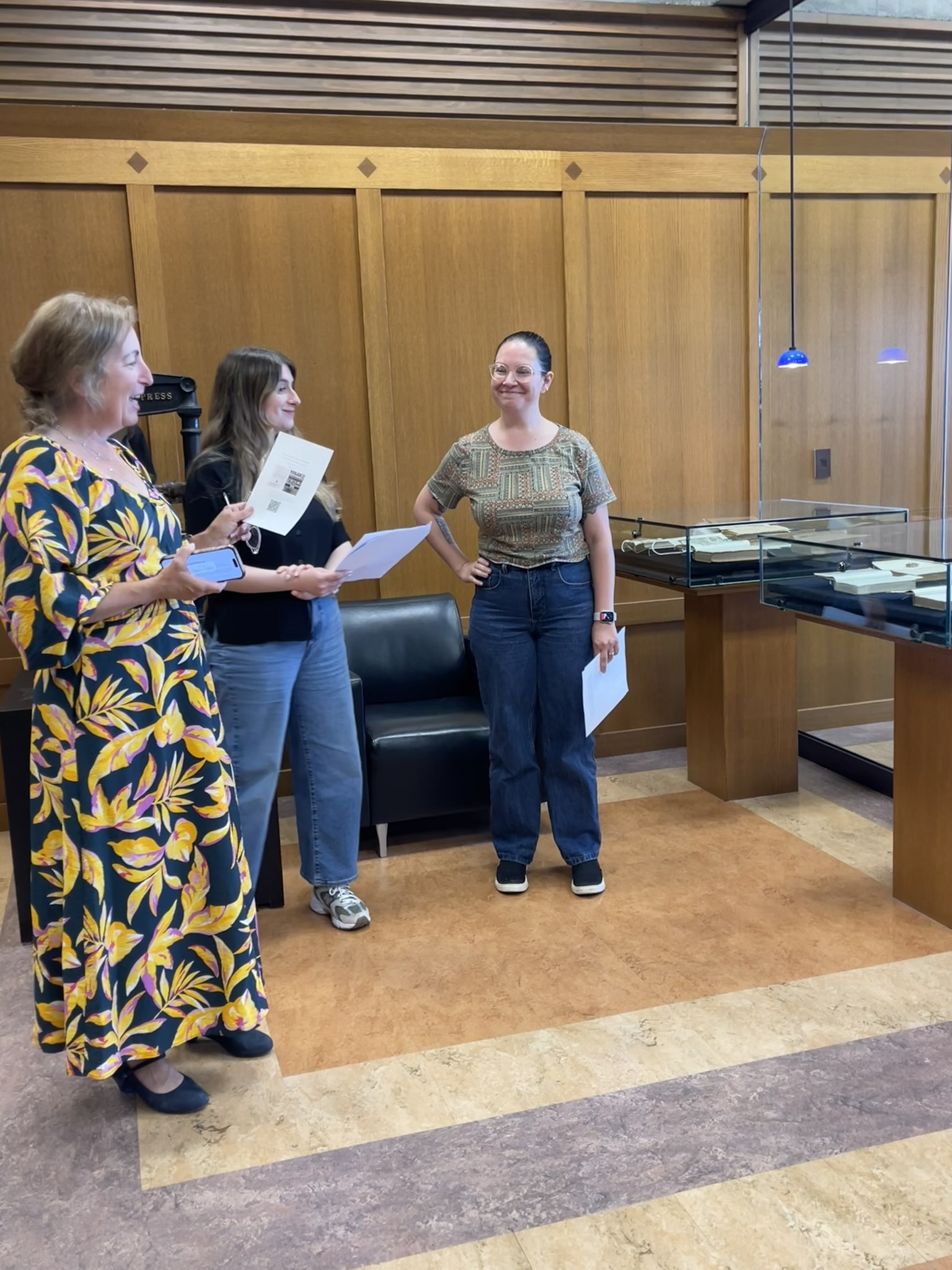
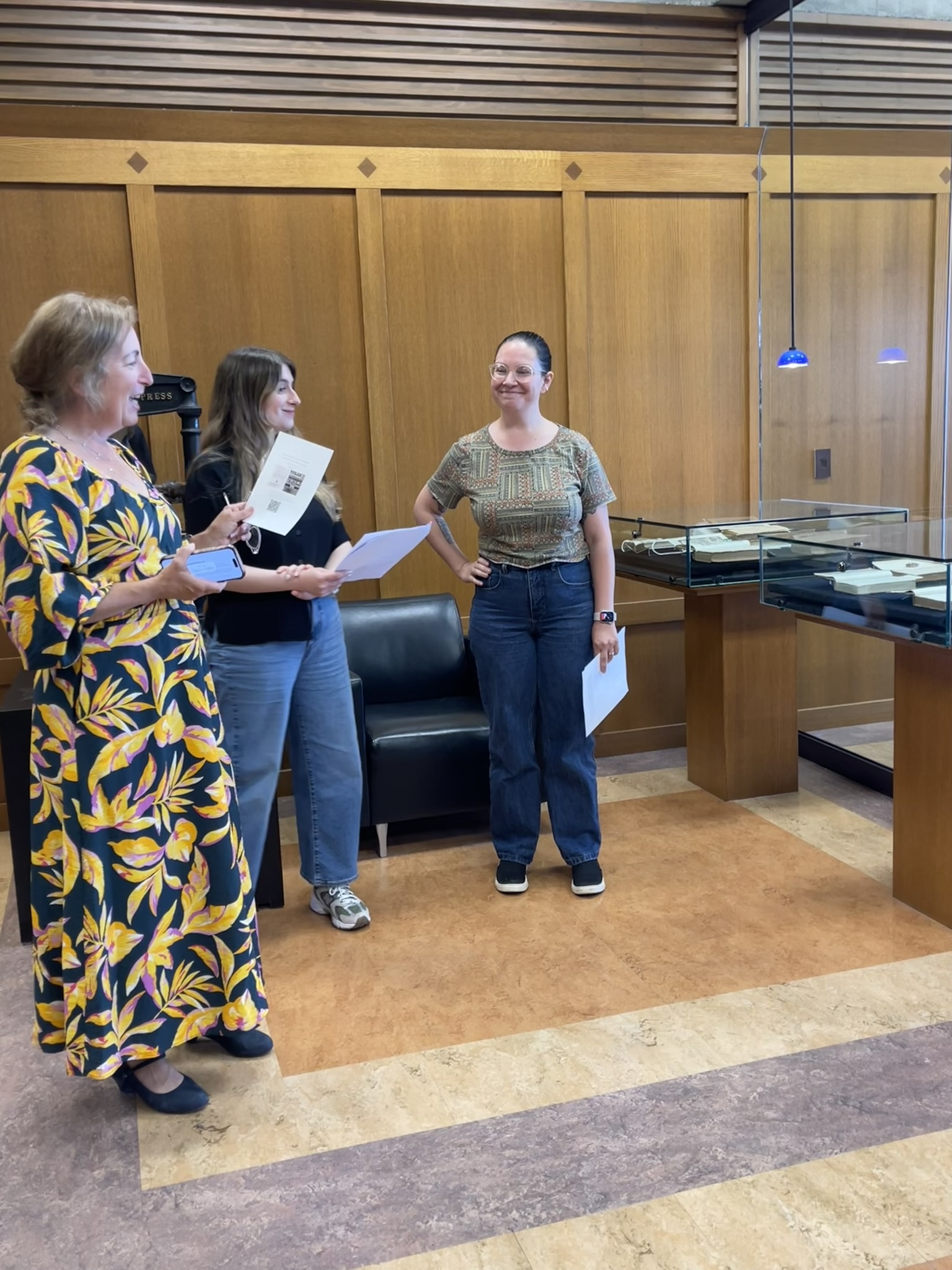
Figure 1. Principal Investigator Dr. Michelle Levy (left) and Research Assistants Isabelle Eist (centre) and Anna Opryszynko (right)
As part of our anniversary wrap event, Principal Investigator Dr. Michelle Levy and Research Assistants Isabella Eist and Anna Opryszyko curated an exhibit outside of Special Collections and Rare Books in Simon Fraser University's W. A. C. Bennett Library. Continue reading for descriptions of the books in each case. For a full list of WPHP Records Referenced and Works Cited, see the attached PDF.
Case 1: M is for Mary, E is for Elizabeth: London’s Widow Publishers, by Anna Opryszko
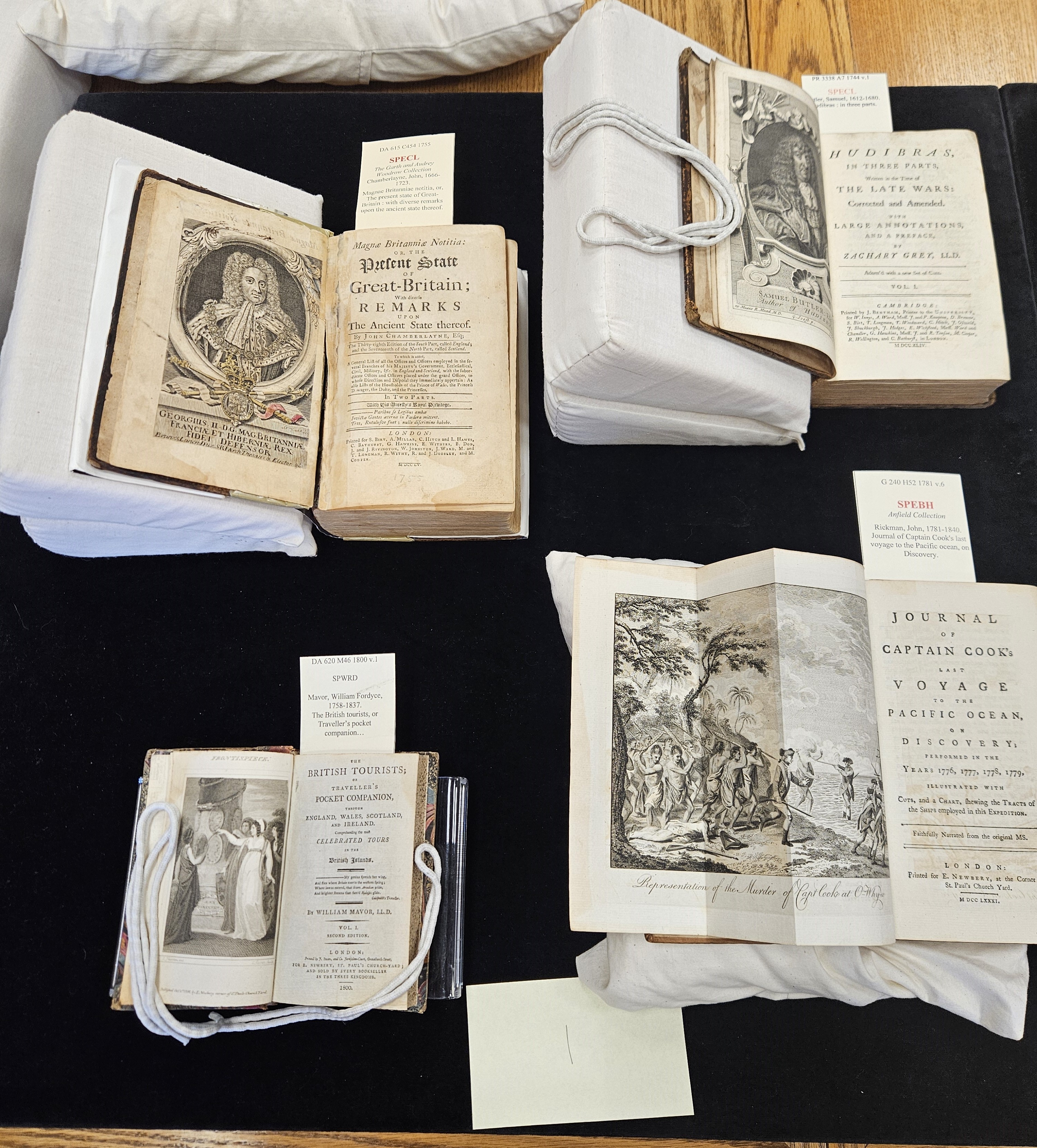
Figure 2. Case 1: Magnae Brittaniae notitia (1755) (top left), Hudibras (1744) (top right), The British tourists (1800) (bottom left), Journal of Captain Cook's last voyage (1781) (bottom right)
Chamberlayne, Magnae Britanniae notitia (1755)
Butler, Hudibras (1744) [vol. I]
Rickman, Journal of Captain Cook's last voyage (1781) [vol. VI]
Mavor, The British tourists (1800) [vol. I]
In the eighteenth century it was not uncommon for women in Europe to work in the book trade alongside their husbands, gaining experience and business acumen, and upon widowhood to inherit professional responsibilities. These women are, for us, hidden in plain sight: imprints refer to them by their first initial and last name, or simply their last name, as was common practice. The books included here feature prominent London publishers and booksellers Mary Cooper, Mary Longman, and Elizabeth Newbery.
Mary Cooper was active as a bookseller and trade publisher in London from 1743 to 1761. She was the widow of the bookseller Thomas Cooper, whose business and connections she inherited. She has been described as “the most stable and influential businesswoman among her contemporaries” (Schneller 112), and of unique economic importance compared to most other women publishers of her time (McDowell). Cooper sold ephemeral materials with a strong consumer base such as political pamphlets, plays, and sensational news.
In Magnae Britanniae notitia (1755), included in the display here, Cooper is joined by Mary Longman in the list of named publishers. Mary Longman was the wife of printer Thomas Longman, founder of the long-running Longman publishing company, who died in 1755. Their nephew, also Thomas Longman, entered the business after his uncle’s death. The “M. and T.” referenced in the imprint is almost certainly Mary and Thomas the nephew, as this naming convention continues into 1756.
Elizabeth Newbery was a bookseller and publisher in St. Paul’s Church-yard. She is credited as being active in the trade from 1780-1821, following the death of her husband Francis Newbery, but it is likely that she was involved in the business before his death. She was best known for publishing children’s books as well as moral and didactic works, reflecting the markets of the time. Newbery held a substantial presence in the trade, publishing over 300 juvenile titles and 200 adult titles during her twenty-two-year career (Shefrin).
Case 2: Women Writers and their Anonymity, by Isabella Eist
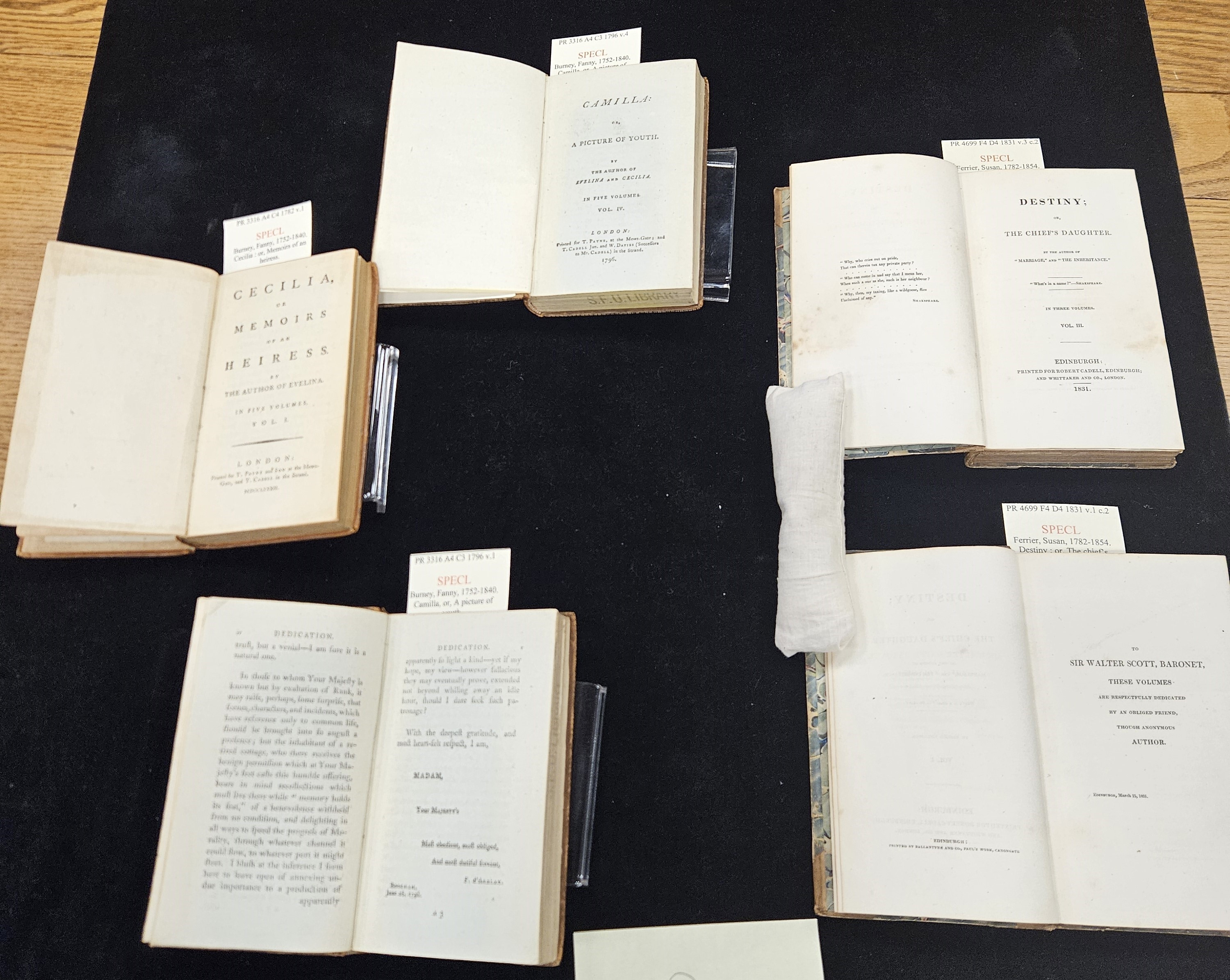
Figure 3. Case 2: Cecilia (1782) title page (top left), Camilla (1796) title page (top centre), Destiny (1831) title page (top right), Camilla (1796) dedication (bottom left), Destiny (1831) dedication (bottom right)
Burney, Cecilia (1782)
Burney, Camilla (1796)
Ferrier, Destiny (1831)
English author Frances “Fanny” Burney (1752–1840) and Scottish novelist Susan Edmonstone Ferrier (1782–1854) offer us two distinct examples of how women writers approached authorship and anonymity in the late eighteenth and early nineteenth century. This case features the first editions of Burney’s Cecilia, or memoirs of an heiress (1782) and Camilla: or, a picture of youth (1796), her second and third novels respectively. Also displayed here is Ferrier’s third novel, Destiny; Or, the Chief’s Daughter (1831). If we define anonymity as the absence of a signed author on the title page, these three novels were all published anonymously. However, considering both paratext and public reception to these texts underscores that each author both understood and utilized the function of anonymity differently.
Following the success of her first novel, Evelina (1778), we can trace the evolution of Burney’s Cecilia across a total of eight London editions published by Thomas Cadell and Thomas Payne and Son, three Irish editions beginning in 1783, two American editions released in Boston in 1793 and 1803, and a handful of others published by smaller presses in England. Significantly, the editions published in Dublin are the only ones to directly name “Miss Burney” as the title’s author, thus prompting us to question if Burney wanted to be recognized in this manner. At the outset of her career, Burney took significant measures to ensure her anonymity when Evelina was published. As a young woman, Burney acted as her father’s amanuensis and aided with Charles Burney’s manuscripts on music history. Not wishing her writing to be recognized, she arranged for a fair copy of Evelina to be “made in a disguised hand, to prolong the mystification” and approached a publisher under a male pseudonym (ODNB, “Burney, Frances”). Later that year, Burney’s identity as Evelina’s author was, “much to her distress,” exposed by George Huddesford in his 1778 satirical poem, Warley, A Satire (ODNB). After her identity was revealed to the public, Burney continued to publish the majority of her works without her name included on the title page, if anywhere at all. As one interesting exception, the publication of Camilla in 1796 (of which volumes I and IV of the first edition are displayed here) included a dedication to the Queen signed under her married name, F. d’Arblay. The shift from pursuing complete anonymity to signing her surname following the dedication suggests that Burney wished to reveal her identity on her own terms, and not because she was expected to after her authorship became public knowledge.
Although a few people guessed at her authorship when Susan Ferrier’s first novel, Marriage, appeared in Edinburgh in 1818, she denied any connection to the text. In a letter to her sister, Ferrier stated that she “could not bear the fuss of authorism!” and asked her friends “to answer impertinent interrogatories by saying that as I [Ferrier] don’t acknowledge it, nobody else has a right to say it’s mine, [and] that is surely no untruth” (Memoir and Correspondence of Susan Ferrier 178). Ferrier maintained her anonymity across all three of her novels and their subsequent editions until 1842 when publisher Richard Bentley—who had purchased the copyrights to Marriage (1818), The Inheritance (1825), and Destiny (1831)—convinced her to move forward with a new edition of Marriage that would include her name explicitly for the first time (ODNB).
Case 3: “The fair triumvirate of wit”: Behn, Manley, Haywood, by Anna Opryszko
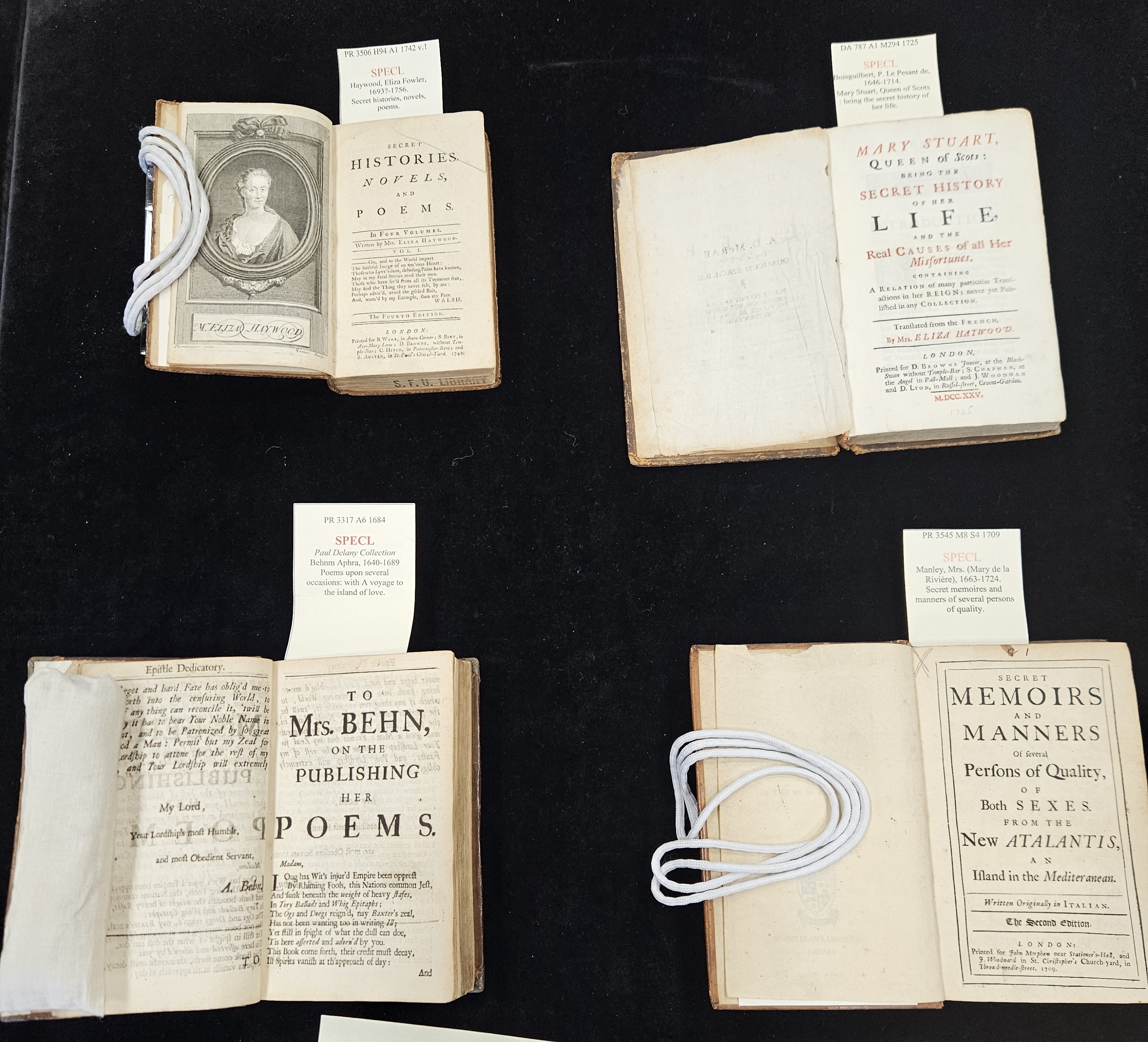
Figure 4. Case 3: Secret histories, novels, and poems (1742) (top left), Mary Stuart, Queen of Scots (1725) (top right), Poems upon several occasions (1684) (bottom left), Secret memoirs (1709) (bottom right)
Haywood, Secret histories, novels, and poems (1742) [vol. I]
Boisguilbert, Mary Stuart, Queen of Scots (1725)
Behn, Poems upon several occasions (1684)
Manley, Secret memoirs (1709)
This case brings together a collection of women writing before 1750 who featured prominently in their literary landscape. In a dedicatory poem to the first edition of Eliza Haywood’s Secret Histories, the Reverend James Sterling names Aphra Behn, Delarivier Manley, and Eliza Haywood as “the Fair triumvirate of Wit,” crediting them as the most influential women writers of the time. Each of these women were public figures in their own way, with status that can be identified by the texts on display here. Behn was well known in her time as a playwright, and her poems are introduced with many dedications detailing her popularity. Haywood ran a bookshop and was therefore quite literally in the public sphere – one of her books displayed here features a full-page portrait frontispiece. Manley’s name is not included on the title page of The New Atalantis, but her authorship was no secret: the lack of printed attribution is related to the controversial content and the intrigue Manley crafted around the book.
Little is known of Aphra Behn’s early life, although it is likely that her family was of modest means, her mother being a wet-nurse, and her father a barber. By her twenties Behn was working as a government agent, possibly first in Surinam and then in Antwerp, and her experience in what was then the Spanish Netherlands is well documented (Todd). She may have written some poems and fiction during this period but by 1670 she turned her attention to the stage. By the late 1670s and into the 1680s Behn was one of the most prolific and productive playwrights in England, and in the last decade of her life she began writing prose. Included in this display is a collection of poems published in 1684, the first of four collections published in that decade, open to one of several flattering dedicatory poems lauding her wit and poetic talents.
Delarivier Manley’s biography is known primarily from her own accounts, including “Delia's Story” inserted in The New Atalantis (1709) and her semi-autobiographical novel Adventures of Rivella (1714). Her writing career began with playwriting in her early adulthood and expanded to include novels, satires, and political journalism. Manley gained notoriety with the 1709 publication of her political satire Secret Memoirs and Manners of Several Persons of Quality, of both Sexes, From The New Atalantis, included in this exhibit. Its publication was initially suppressed and Manley arrested for libel, but the work found massive and enduring popularity once the charges were dropped. Considered a scandalous character of her time, Manley is now seen as “an early exponent of Enlightenment feminism” (Ballaster).
Eliza Haywood was an actor, a publisher, and is best known as the writer of novels, plays, translations, and periodical essays. Her career spanned from 1719 to 1756 and she has been credited with being “one of the most important founders of the English novel” (Backscheider). This display includes one volume of her collected Secret Histories, Novels, and Poems, first published in 1725. This publication was popular enough that a second edition was published within the year. Also included is Mary Stuart, Queen of Scots, a work which was long thought to have been an original creation by Haywood but has now been identified as a translation of Pierre Le Pesant de Boisguilbert's Marie Stuart, reyne d’Escosse (McMurran).
Case 4: Joanna Baillie: capturing four of six decades of lifetime editions, by Michelle Levy
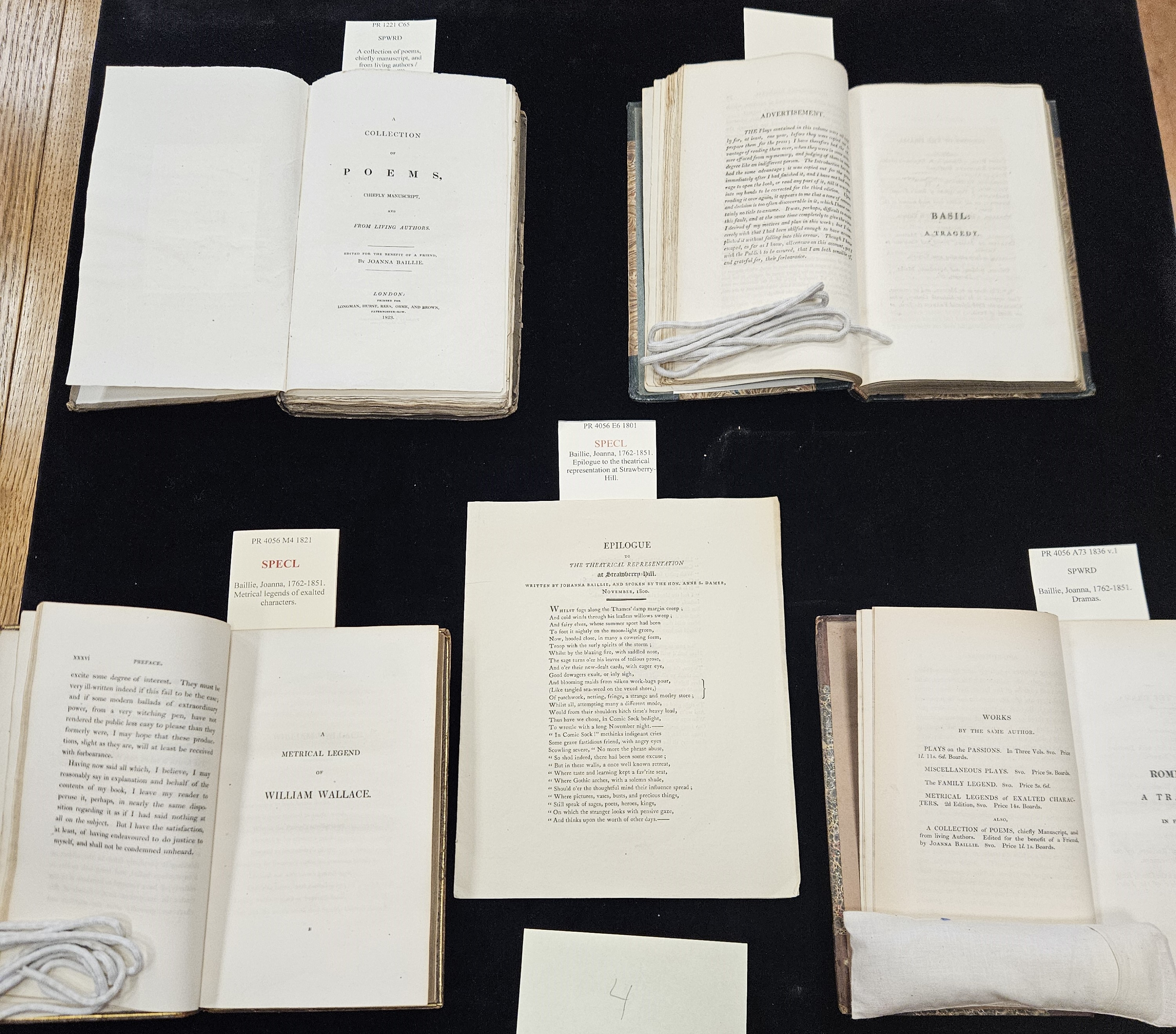
Figure 5. Case 4: A Collection of Poems, chiefly manuscript, by living authors (1823) (top left), Series of Plays (1806) (top right), Metrical Legends (1821) (bottom left), Epilogue to the theatrical representation at Strawberry Hill (180?) (bottom centre), Dramas (1836) (bottom right)
Baillie, Series of Plays (1806)
Baillie/Damer, Epilogue to the theatrical representation at Strawberry Hill (180?)
Baillie, Metrical Legends (1821)
Baillie, A Collection of Poems, chiefly manuscript, by living authors (1823)
Baillie, Dramas (1836)
Joanna Baillie is one of the most fascinating women writers of the period to study given the complexities of her publishing history and the conflicting nature in which she presented herself to the public. Baillie enjoyed a six-decade career in print: she first appeared with a volume of poems in 1790, and was in print until the year of her death, in 1851, when an 847-page single volume, doublecolumned edition of her complete works, The dramatic and poetical works of Joanna Baillie, was published. Newly edited by her, it appeared under the imprint of her long-time publisher, Longman, with whom she was also close family friends. This work, as well as everything published after 1836, is not included in The WPHP, one of limits of the data we collect. Baillie, like many women of the period, lived until old age, in her case 88, and as we needed to stop somewhere, we do not collect all the lifetime editions for all women. However, what we do include demonstrates the range of her publications.
Baillie published in many genres, chiefly poetry and drama. Her A Series of Plays on the Passions presents a highly complex publishing history. The three volumes were issued over the course of fourteen years: Volume 1 first appeared in 1798, Volume 2 in 1802, and Volume 3, a decade later, in 1812. New editions, such as the one on display, the fifth edition of the first Volume, appeared in other years, this one in 1806. A further addition, labelled Volume 4, was published under the title Dramas, appeared in 1836, which she said, were to “see the completion of the whole” project, first begun in 1798. As such this series of plays came out over a period of nearly four decades. From surviving correspondence and publisher records, we know that Volume 1 was published on a 50/50 profitsharing basis with Cadell & Davies in 1798; she was dissatisfied with this arrangement, and so she sold the copyright for Volume 2 to Cadell & Davies. For Volume 3, she published on a profit-sharing basis with Longman, however, they agreed to give her two-thirds of the profit. The financial arrangement for last installment in the series, Dramas, in 1836, in three volumes, is unknown. Baillie wrote what are known as closet dramas, even though she wished for them to be performed on the stage and they were, infrequently and never for long runs.
Baillie is an intriguing case of a woman who was a shrewd and highly critically acclaimed author, although her works never sold well and she does not appear to have earned large sums from her publications. The one work for which she appears to have struck a very lucrative bargain is her Metrical Legends (1821), for which she may have been paid up to a thousand guineas in anticipation of its success as a series of narrative poems modelled on those of Walter Scott. However, the poems were not hugely success, and were published in two editions. From correspondence it seems that Baillie may have done the unthinkable and agreed to return some of the payment she received to Longman.
Baillie, even though a published and highly acclaimed writer, also wrote for domestic audiences and charitable purposes. She solicited and gathered poems to be included in A Collection of Poems, Chiefly Manuscript, and from Living Authors (1821), and published them by subscription to aid an unnamed friend, whom Thomas McLean has identified as Mrs. James Stirling, a friend and former schoolmate of Baillie’s, who was widowed with four daughters and living in dire poverty. Baillie was evidently tireless in her efforts, amassing hundreds of poems, many previously unpublished, and 1573 subscribers are named in the volume. An interesting item in SFU’s collection also speaks to this other aspect of Baillie’s career. It is a privately printed epilogue that Baillie wrote for an evening of amateur theatricals to be held at Horace Walpole’s Strawberry Hill in November 1800. The epilogue demonstrates that Baillie knew Strawberry Hill and Walpole, and his circle (which included his cousin and goddaughter, the sculptor Anne Damor, who was to have performed the epilogue). It seems likely that Baillie’s plays were performed at these events. The misspelling of Baillie’s first name also situates the printing within the realm of an amateur publication.
Case 5: “The work of a female friend”: Dorothy Wordworth in print, by Michelle Levy
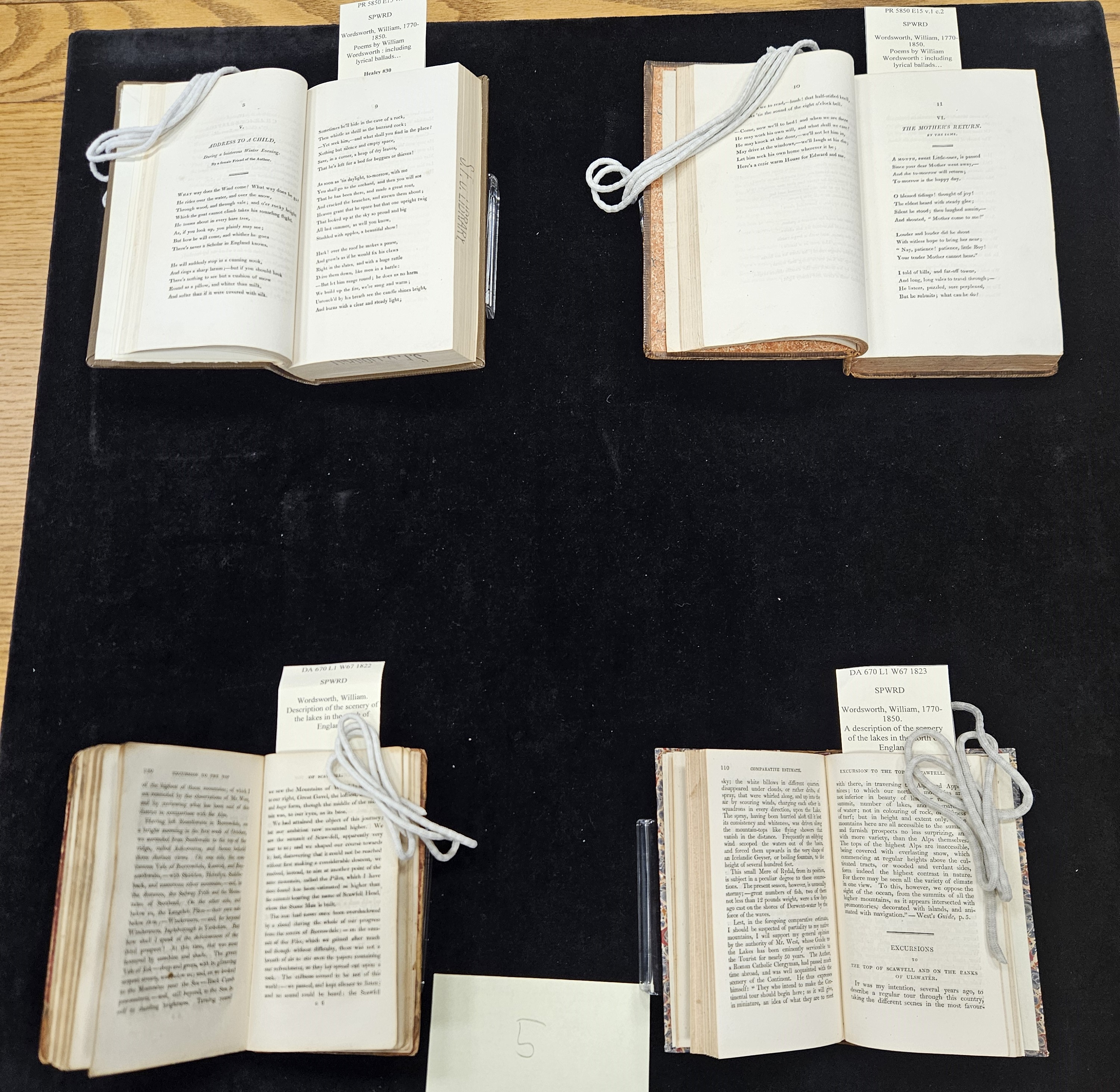
Figure 6. Case 5: Poems by William Wordsworth (1815) (top left and right), Description of the Scenery of the lakes in the North of England (1822) (bottom left), Description of the Scenery of the lakes in the North of England (1823) (bottom right)
Wordsworth, William. Poems by William Wordsworth (1815)
Wordsworth, William. Description of the Scenery of the lakes in the North of England, 3rd edition (Longman, 1822)
Wordsworth, William. Description of the Scenery of the lakes in the North of England, 4th edition (Longman, 1823)
Wordsworth, William. A Guide through the District of the Lakes (1835)
Wordsworth, William. Poems, Chiefly of early and late years (1842)
“Dorothy Wordsworth is probably the most remarkable and the most distinguished of English writers who never wrote a line for the general public” (I: v). So wrote Ernest de Selincourt, Wordsworth’s most esteemed modern editor, in 1941.
But how accurate is de Selincourt’s assessment? While it is true that most of Wordsworth’s writing originated in and was intended for an audience consisting of her brothers and close friends, her writing was shared more widely through manuscript copies. Furthermore, as early as 1815, her writing began to appear in her brother’s publications. Though usually unattributed, those within Dorothy’s circle knew that these poems and prose were hers; furthermore, she herself would have known as early as the composition of her journals, beginning in 1800, that her brother borrowed from them, at times heavily, for his poetry.
In this case, we find evidence of Dorothy Wordsworth’s contributions to her brother’s publications. In volume 1 of Poems by William Wordsworth (1815) three poems appear: “An Address to a Child, During a boisterous Winter Evening” (pp. 8–10), “The Mother’s Return” (pp. 11–13), and “The Cottager to Her Infant” (p. 160). In his famous “Preface” to this collection, William noted, “Three short pieces (now first published) are the work of a Female Friend; and the Reader, to whom they may be acceptable, is indebted to me for his pleasure; if any one regard them with dislike, or be disposed to condemn them, let the censure fall upon him, who, trusting in his own sense of their merit and their fitness for the place which they occupy, extorted them from the Authoress” (xli). For the siblings’ longtime friend Charles Lamb and his sister Mary, however, this was overly coy. In a 7 April 1815 letter to William, Charles Lamb remarks, “We were glad to see the poems by a female friend. The one of the wind is masterly, but not new to us. Being only three, perhaps you might have clapt a D. at the corner and let it have past as a printer’s mark to the uninitiated, as a delightful hint to the better instructed. As it is, Expect a formal criticism on the Poems of your female friend, and she must expect it” (6:458).
In fact, William kept this attribution throughout his lifetime editions. He did eventually accept this advice but only for her poem, “Floating Island at Hawkshead,” which appears with an initial “D.” in his 1842 collection Poems, Chiefly of early and late years.
Dorothy’s prose account of an ascent up Scafell Pike features in the anonymously published third edition of her brother’s Description of the Scenery in the North of England, known by its later title, the Guide to the Lakes, which appeared in June 1822. This narrative is unattributed, and indeed it is presented in such a way that it appears to have been written by, and recollecting the experience of, William. Another and even longer prose addition of Dorothy’s unpublished travel accounts appeared in the 1823, fourth edition of Description of the Scenery in the North of England. This narrative chronicles the siblings’ 1805 excursion to Ullswater.
Because we know so much about the Wordsworths, and because many of their manuscripts survive, we are able to attribute these poems and narratives to Dorothy, and thus they are included in The WPHP title records. But for every woman like Dorothy Wordsworth there are likely dozens of invisible women who contributed to print but who left no trace behind, and whom we therefore cannot capture in The WPHP.
Case 6: Women Printers and Publishers: Locating Ann Vernor, by Isabella Eist
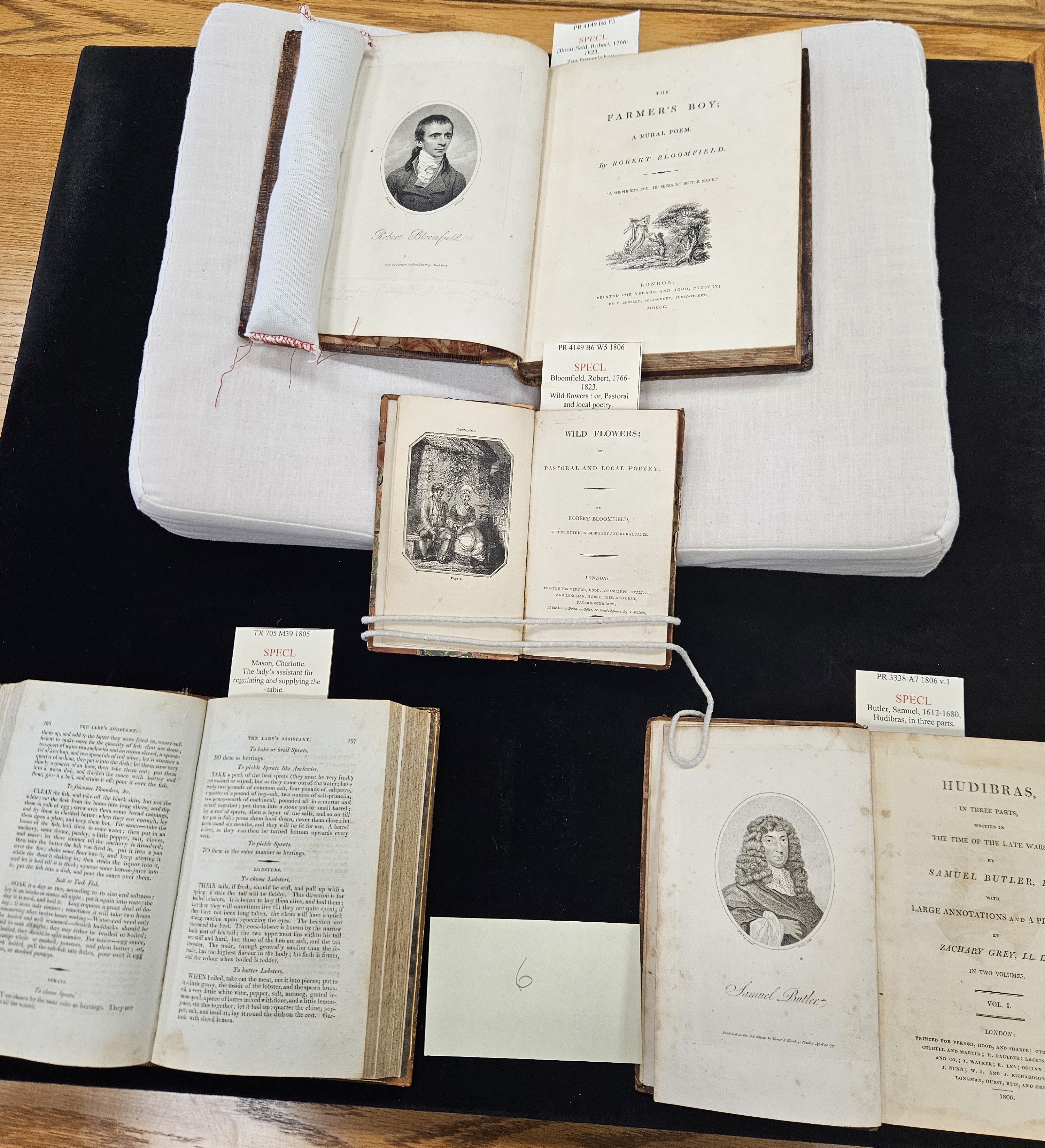
Figure 7. Case 6: The Farmer's Boy; A Rural Poem (1800) (top), Wild Flowers; Or, Pastoral and Local Poetry (1806) (centre), The Lady’s Assistant For Regulating and Supplying the Table (1805) (bottom left), Hudibras (1806) (bottom right)
Bloomfield, The Famer’s Boy; A Rural Poem (1800)
Butler, Hudibras (1806)
Mason, The Lady’s Assistant For Regulating and Supplying the Table (1805)
Bloomfield, Wild Flowers; Or, Pastoral and Local Poetry (1806)
Though they are generically diverse and written by three different authors, the four titles displayed in this case are linked by a specific, though historically uncredited, publisher: Ann Vernor. In the imprint for each title—Robert Bloomfield’s The Farmer's Boy (1800), Charlotte Mason’s The Lady’s Assistant (1805), Bloomfield’s Wild Flowers (1806), and Samuel Butler’s Hudibras (1806)—the publisher is named as “Vernor and Hood,” and later as “Vernor, Hood, and Sharpe.” In the Women’s Print History Project’s 2022 spotlight, “Hidden in the Imprints,” I detailed my unconventional research process after learning that Thomas Vernor had in fact been deceased since 1793 despite the name “Vernor” appearing consistently in imprints over the next nineteen years. A successful publisher, bookseller, and owner of a circulating library in London, Thomas Vernor worked with a variety of male business partners between 1764 and his death in October 1793. Observing that his last name continued to appear in imprints without cessation, I concluded that an immediate relative assumed his position in the firm, as was typical at the time. Whether this successor was his widow (unnamed in all scholarly sources The WPHP typically consults outside of a brief reference to a “Mrs. Vernor” in Ian Maxted’s Exeter Working Papers in Book History) or his son, George Glas Vernor (who appears in the BBTI as an Apprentice of the Stationers’ Company), was inconclusive. Through my research, I gathered conclusive evidence that Ann Vernor, the woman named only as the “relict of Mr. Thomas Vernor” in her obituary in The Times, took over the running of her husband’s publishing house in 1793 (Exeter).
Several critical pieces of evidence emerged as I sought to prove Ann Vernor’s involvement in the book trades. I first discovered an insurance record in Ann Vernor’s name, preserved in the London Metropolitan Archives catalogue, that corroborates Ann Vernor’s position as co-owner of the firm. I then located George Glas Vernor’s burial record in the England and Wales Non-Conformist Record Indexes. This document records his death in April 1796, thereby confirming that George Vernor could not have been operating in the firm after that date. Finally, I located and transcribed Thomas Vernor’s will, which offered the principal evidence that Ann Vernor’s work in the firm directly followed Thomas Vernor’s death—and never involved their son—as per his stated wishes. In his will, Vernor asserts that “it is my will and desire that my present Business of a Bookseller now carried on in Birchin Lane be carried on by and between my said Executrix...and my partner Thomas Hood in the same manner as late” (“Will of Thomas Vernor”). Specifying the role of his executrix (Ann Vernor) in the continuation of his firm allows us to infer that her partnership with Thomas Hood began before Thomas Vernor’s death. This inference stands as the most logical way to interpret Thomas Vernor’s request that Ann Vernor and Hood carry on the business “in the same manner as late.” After all, it is unlikely that Thomas Vernor would have entrusted his wife with the business if she lacked previous experience running the firm as his health declined. A subsequent provision in Thomas Vernor’s will named both his wife and son as beneficiaries, but stipulated that George Vernor was to receive “the sum of Eighty pounds per annum…as [Ann Vernor] may see [fit]” only “if the conduct of my said son shall prove commendable and satisfactory to my Executrix” (“Will of Thomas Vernor”). These sections of the will outline Thomas Vernor’s ongoing concerns surrounding his son’s behaviour, emphasizing that George would not have been trusted with co-ownership of the firm.
Though she worked alongside Thomas Hood (and later Charles Sharpe, who joined the firm in 1806) for over thirteen years, Ann Vernor was never named directly in any of the imprints that were published when she was running the firm with Hood and Sharpe. It is important to acknowledge how significant Ann Vernor’s heretofore unrecognized contributions to the London book trades were. During her tenure with the firm from 1794 to 1807, the Vernor name appears in the imprints of 656 titles collected in the English Short Title Catalogue. By contrast, “Vernor” appears in the imprints of only 140 titles while Thomas Vernor was alive. Though it is possible that the ESTC does not capture all the titles Thomas Vernor published, this disparity is nonetheless striking and indicates that Ann Vernor contributed to the firm becoming significantly more prolific following her husband’s death. Today, she is beginning to receive credit for her contributions in the scholarly and bibliographic sources that book historians and databases like The WPHP rely on to trace women’s labour. Recent scholarly recognition of Ann Vernor’s work appears in both the Benard Quaritch and McMaster University’s Archives & Research Collections catalogues of women printers, publishers, and booksellers.
The titles displayed in this case highlight the wide range of readers that Ann Vernor’s publications catered to. Visitors to her Birchin Lane and Poultry bookshops could expect to browse offerings including Charlotte Mason’s domestic advice on cooking and keeping the home, Samuel Butler’s posthumously reprinted satire, and Robert Bloomfield’s pastoral verse. The latter’s work is of particular interest because of Bloomfield’s (1766-1823) unique position as a labouring-class poet and shoemaker from rural Suffolk. His first publication, The Farmer’s Boy (1800), gained significant popularity and went on to fourteen subsequent editions and a Latin translation. A first edition of The Farmer’s Boy appears in this case and bears the Vernor name in its imprint, demonstrating Ann Vernor and Thomas Hood’s willingness to take a chance on an unknown shoemaker’s poetry even after three other publishers in London “had rejected the work” (ODNB, “Bloomfield, Robert”). While Bloomfield’s second collection of poems, Wild Flowers (1806), saw less commercial success than The Farmer’s Boy, his position as an influential Romantic poet—owing in no small part to praise by William Wordsworth, Robert Southey, and Samuel Taylor Coleridge—was then already established (ODNB).