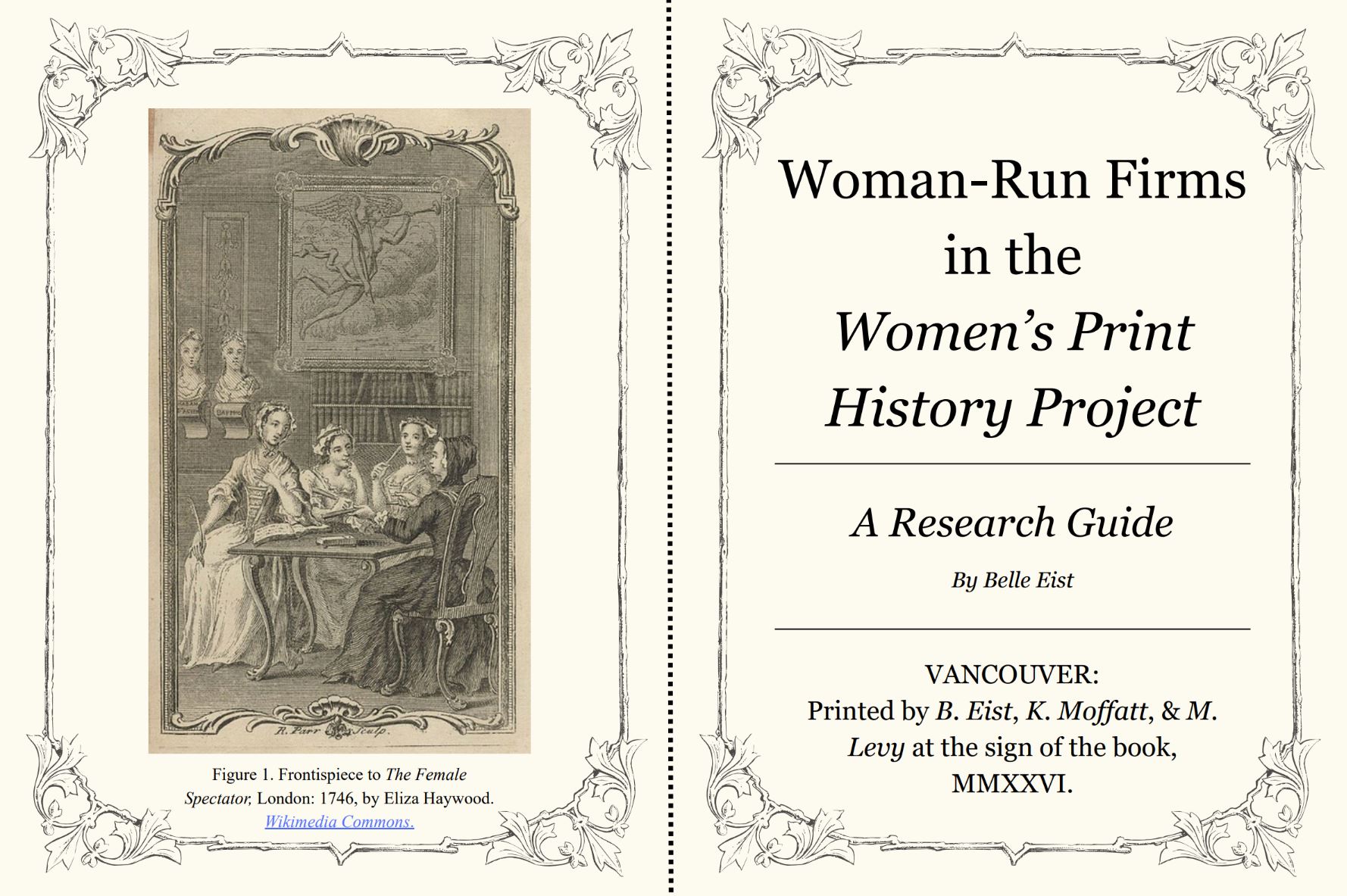
This post is part of our Ten Years of the WPHP Spotlight Series, which will run through August 2026. In May 2026, the WPHP held two wrap events to celebrate over a decade of collaborative data creation and research, showcasing some of the projects that have emerged in the process. This series shares these projects along with further reflections from the creators and researchers.
Authored by: Isabella Eist
Edited by: Kate Moffatt and Michelle Levy
Submitted on: 08/14/2026
Citation: Eist, Isabella. "Woman-Run Firms in the Women’s Print History Project: A Research Guide." The Women's Print History Project, 14 August 2026, https://womensprinthistoryproject.com/blog/post/155.
To see the full stylized version of this Research Guide, please download the attached PDF.
Preface
This research guide walks users of the Women’s Print History Project through the process of locating and interpreting the data we collect on women working as printers, publishers, and booksellers between 1700 and 1836. Designed for students, scholars, or anyone fascinated by book history, this guide sets up users of the database for success in their inquiry. Together, we will review significant terminology that appears throughout the database, unpack the structure of our firm records (which track the chronology and locale of individuals working in the book trades), and learn more about how you can use the data the WPHP compiles as a tool in your own research. Focusing on Eliza Haywood (1693-1756) as a case study, we explore how the WPHP team marries bibliographic data with archival research to gain further insight into the often understudied careers of eighteenth-century women working in the book trades. As an industry, printing, publishing, and bookselling underwent significant transformation throughout the long eighteenth century. Examining the imprints that came out of Haywood’s bookshop both helps us contextualize these shifts and reveals the limits of the data available to us to reach some enumerative conclusions around woman-run firms.
Navigating the WPHP: A Note on Vocabulary
Before we jump into how the interested student, researcher, or eighteenth-century superfan can use the Women’s Print History Project to learn more about the many understudied women working as printers, publishers, and booksellers, it is important that we are all on the same page.
The following section details some of the terminology we employ in the database to describe and catalogue women’s labour in the book trades.
Printer
A “printer” in the WPHP denotes the firm responsible for compositing and printing the work. Usually indicated by the phrase “printed by” in the imprint and/or the colophon.
Publisher
“Publisher” represents the firm that takes on the financial responsibility for the editing, printing, and distribution of the work. Typically indicated by the phrase “printed for” in the imprint. In the event that a work has been self-published (“printed for the author”), this will be noted in the Self-Published field.
Bookseller
“Bookseller” indicates the firm from which the work can be purchased. Usually designated by the phrase “sold by” in the imprint.
Imprint
Information (usually including names and addresses) on the printers, publishers, booksellers involved in a title’s production as shown on the bottom of the title page.
Person Record
In the WPHP, our person records catalog the contributors to a specific title in our title table. These contributors span various roles encompassing authors, editors, translators, illustrators, booksellers, publishers, printers, and more. A visitor to the database will find in our list of persons records women who have contributed, across various roles, to the creation, publication, and sale of books in the long eighteenth century. Notably, our person records also include the men who contributed to the creation of titles produced by women authors or firms. Some of our person records feature women who (as we know from our sources) worked in the book trades but for whom we may not have any titles to attach. This pattern represents a common but unfortunate symptom of a historical and textual record that frequently obscures women’s labour in the book trades. If a woman participated in a title’s publication—and her involvement was preserved textually—that title will end up in the WPHP and all other contributors (regardless of gender) who worked on that title in prominent roles will appear as either person or firm records depending on their individual role. For women who have both a firm and persons record in the WPHP, looking at her person record will provide the fullest picture of her work across various roles within the book trades.
Firm Record
Our approach to cataloging book-trade businesses draws on and compiles existing data to provide a fuller picture of women’s labour in the long eighteenth century than exists elsewhere. Firm records in the WPHP represent the printers, publishers, and booksellers named in the imprint or colophon of our title records. Our firm table also includes additional woman-run book-trade businesses that may not have any titles attached to their record. Recognizing that many types of printed material (and especially ephemera like pamphlets and newspapers) were not preserved, catalogued, and digitized at the same frequency as, for instance, novels by popular male authors, we record all women working in the book trades regardless of whether we have access to the titles they produced.
Relying on the information provided in imprints, colophons, and sources like the British Book Trade Index, our firm records track the name, gender, business address, start and end dates of work at that address, and further relevant information for that firm. We categorize firms that included at least one woman as female to aid in searchability. Because the roles of printer, publisher, and bookseller were at times nebulous in their definition across the century, we specify the role a firm played in each title’s publication. Numerous firms in the database acted in multiple roles across the titles they worked on. As it was common for firms to move locations around their city of operation, the WPHP creates additional firms to account for multiple addresses and the varying years of operation at each location.
More on Firms
For one example of a female firm that worked across more than one address and in multiple roles we can look to the Dublin-based printer Alice Reilly. Reilly first worked with Edward Exshaw at their Cork Hill address from 1741-1744, then worked alone at the same location until 1762, and finally moved to her Temple Bar address from 1763-1767. Over the course of her career, Reilly was foremost a printer (typically indicated by language like “printed by” in the imprint), but the WPHP also includes two titles (see title ID 14532 and 14537) on which Reilly is also attached as a publisher (for whom the title is “printed for”) or bookseller (for whom the title is “sold by”). Realistically, however, Reilly was not formally working as a publisher or bookseller despite what was indicated in those two imprints. In her spotlight on the Dodds, “What Does it Mean to Publish?,” Kate Ozment reminds us that before the late eighteenth century “what labour imprint language signifies is much more difficult to parse with certainty, and the roles we align with responsibilities in a book’s production shift from [later standardized] divisions.” Nonetheless, because the WPHP focuses on representing books and the labour involved in their creation as it was presented to and understood by their readership, we follow the language of the imprint even as we understand that the boundaries between printing, publishing, and bookselling were complex.
Bonus! If you’re hungry for more information on Reilly’s interesting career, check out the WPHP Monthly Mercury podcast episode “Address-ing Firms; or, The Consequences of Our Own Actions” to hear Kate Moffatt take a deep dive into discovering Reilly’s working addresses.
Related Firms
Related firms denote additional firms that are related (usually through the familial or business relationships of the firm’s members) to a specific firm record in the database.
With our vocabulary sorted, we can now turn our attention to how the database can help us construct a broader understanding of the women creating, publishing, and distributing texts in the long eighteenth century.
Printed for Eliza Haywood, at the Sign of Fame in Covent-Garden
What defines a successful career in the book trades in the long eighteenth century? Should we measure success by an individual’s output (the sheer number of editions they were involved in producing), the variety present within their body of work, or the impact of their work within their social context? One thing we can be certain of is that these are complex questions that call on us to consider a host of external factors in constructing a nuanced answer. We must, for instance, be mindful of the patriarchal and Eurocentric landscape of eighteenth-century print culture in posing these questions about women or people from minoritized groups working in the book trades. So, with this context in mind, how do we go about collecting evidence to begin exploring these questions? The bibliographic and biographical data the Women’s Print History Project collects offers us a useful starting point in our inquiry process.
As a historically under-researched population in book history scholarship, it can be difficult to find detailed information about women working as printers, publishers, and booksellers. Bibliographic resources such as the English Short Title Catalogue, British Book Trade Index, or American Antiquarian Society offer great insight into the creation and publication of printed media in the long eighteenth century, but because they do not track gender, women’s contributions to print are often difficult to discover and trace. For those interested in learning more about a particular woman-run firm, turning to the WPHP’s firm records can help us determine the timeline and locale of her operations, locate business partners and collaborators, and track how many works she was involved in producing. Using Eliza Haywood (née Fowler) as a case study, this research guide explores how the data the WPHP collects can create a more holistic picture of eighteenth-century women’s careers within a male-dominated trade.
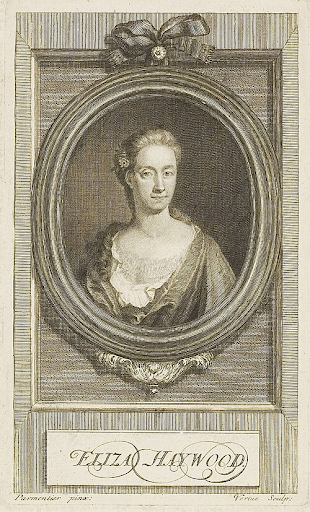
Figure 2. Engraving of Eliza Haywood by George Vertue. Wikimedia Commons.

Eliza Haywood’s person record in the WPHP—which catalogs 234 titles authored, translated, or sold by her—certainly presents a picture of a successful, prolific author. As the WPHP’s timeline feature shows, Haywood was a bit of a genre-chameleon and wrote novels, verse, plays for stage adaptation, periodicals, and political texts (most of which were distinctly anti-Walpole and anti-ministerial).
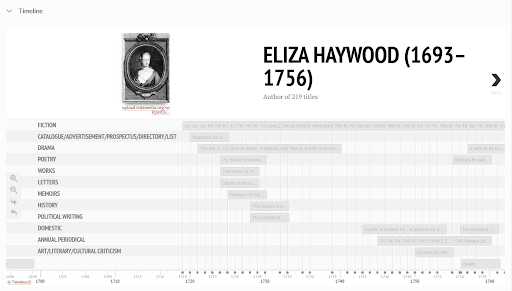
Figure 3. The timeline of Haywood’s publications included in her person record in the WPHP highlights the diversity of styles and genres she engaged with as an author.
As an author, Haywood’s career is comparatively well-studied; of the 143 sources the WPHP cites across all its records, one is devoted entirely to Haywood’s career (A Bibliography of Eliza Haywood). The time Haywood spent as a bookseller and publisher, however, has attracted less scholarly attention. Compared to the 219 editions authored by Haywood, we are only able to confirm that she sold 6 titles and published 4 others. The disparity between the number of works she authored and the number she sold or published is a likely contributor to the challenges our team faced in finding detailed and reliable information about her work as a firm.
Taking a look at the data included in Haywood’s person record and firm record reveals a reasonably comprehensive outline of her life and career. In her person record, for example, the inclusion of birth and death dates, a place of death, a Wikipedia entry link, and an image link represents data points that many other women in the database—and especially female publishers, printers, and booksellers—do not have. Considering the patriarchal landscape of eighteenth-century London and the lack of attention to women’s work in the book trades, that we have as much information as we do about Haywood’s work as a woman-run firm is somewhat unusual. But for Haywood’s impressive corpus as an author—which spawned more research devoted to her life than most women of the period receive—we would likely have limited data available to shape our understanding of the time she spent running a bookstore. Many of the women working at the same time as Haywood represented themselves with only a surname on the titles they worked on, as publicly identifying their gender could negatively impact their business. Further, records of women’s work in the book trades were frequently obscured behind data about their male business partners or family members. This process of obscuring or effacing women’s labour often happened at the source; many women who succeeded their husbands or worked alongside male collaborators were not represented in the imprints or colophons of the titles they produced. It also continues today, as most traditional bibliographical and archival sources do not include gendered data, making it more difficult for researchers to recognize women’s contributions. To build the most complete record possible, the WPHP team researches every woman included in our firm and person tables in order to ‘verify’/‘final check’ the information included in records. Most firm records are created based on the imprints or colophons included in our title records. Typically, imprints and colophons provide us with the firm’s name (sometimes a full name, often just a surname and first initial), the location the firm operated out of (usually the city, sometimes the street address), and the date that specific title was published. To compile more information on a firm, we utilize sources such as the British Book Trade Index, The Scottish Book Trade Index, The Exeter Working Papers, and several others to populate as many data fields in each firm record as possible. If no additional context can be found on a woman-run firm within our standard sources, our team will engage in our speciality—research ‘rabbit holes’—to attempt to find other reliable data about that woman. Unfortunately, a lack of existing sources and research means that we are often unable to discover more information about a particular woman working as a bookseller, publisher, or printer.
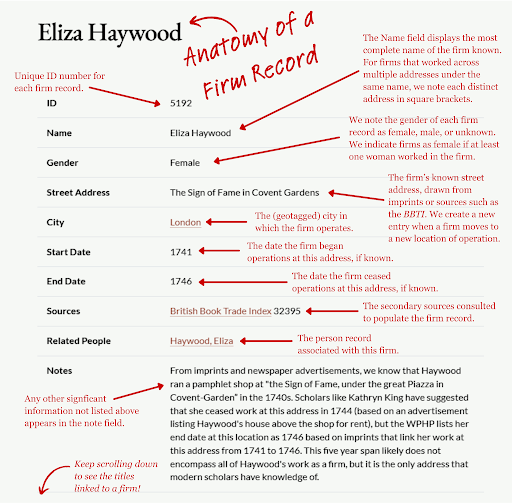
Figure 4. Eliza Haywood’s firm record in the WPHP includes information in every data field. The dearth of research around women’s labour in the book trades for much of the previous century means that we are unable to include this level of data for many female-run firms in the database.
In contrast to Haywood’s comprehensive record, the firm record of London artist and publisher Mary Lawrance is noticeably thinner. While Lawrance’s work as a botanical illustrator has been somewhat preserved in the historical record (as evidenced by her short Wikipedia entry), information about how she published and sold her books is not freely available. Imprints give us her address and name, but even through further research in our usual sources and others we were not able to discover the dates she operated or any further details.
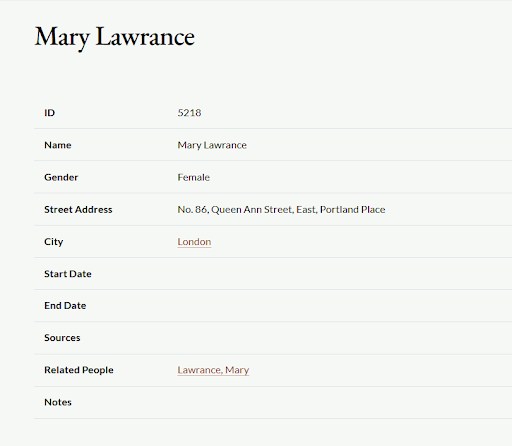
Figure 5. In contrast to Haywood’s record, Mary Lawrance’s firm record does not include a source or start and end dates for her work at that address. With little research available on Lawrance, we had to rely on imprints to supply the information we do have for her career.
Eliza Haywood provides us with a unique opportunity to examine a woman’s career and have a variety of research and data at our fingertips. That said, the data available in the sources the WPHP usually consults provided an incomplete understanding of Haywood’s time at her shop located at the “Sign of Fame in Covent Gardens.” Further research enabled the WPHP team to add additional data to Haywood’s firm record and confirm her role in the publication or sale of ten titles.
Initially, the BBTI provided a start and end date for Haywood’s work at the “Fame” address of 1742-1746. The English Short Title Catalogue records only three titles associated with Haywood’s firm: The Virtuous Villager (1742), A Remarkable Cause (1742), and The Right Honourable Sir Robert Walpole (1746). Recognizing that it seems highly improbable that Haywood had a hand in only these three titles during that time, the WPHP team turned to sources like the Seventeenth and Eighteenth Century Burney Newspapers Collection, Kathryn King’s A Political Biography of Eliza Haywood (2012), and Kate Ozment’s research on Haywood in “Women’s Labor in the Mid-Eighteenth-Century English Literary Economy” (2021) to broaden the parameters of our search. Searching for Haywood’s name and the relevant date range in the Burney Collection returned a handful of advertisements (including the image depicted below) for titles available for purchase at Haywood’s shop at the Sign of Fame. Significantly, Haywood’s name does not appear anywhere in four of the five titles listed in this advertisement. Without this advertisement, contemporary scholars interested in Haywood’s career in the book trades would have no way to link her labour to these four titles.
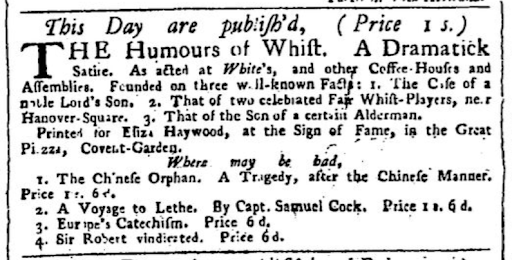
Figure 6. A section of the Jan. 13, 1744 issue of the London Daily Advertiser listing five new titles available at Haywood’s shop. Burney Newspapers Collection. Gale Document No. Z2000149182.
Diving deeper into the research available on Haywood as a book trade actor, rather than an author, brought us to an important source on Haywood’s tenure at her shop in Covent Garden. Using imprints and advertisements, Kathryn King’s research affirms that Haywood began operating her bookstore in 1741, a year earlier than the BBTI records. After discovering a notice advertising the sale of “the genuine Houshold Goods of Mrs. Eliza Haywood, Publisher” in the Daily Advertiser, King was able to confirm that “from December 1741, or thereabouts, until April 1744 Haywood lived above the corner shop at an address that the slightly later numbering system would identify as No. 18–19 of the Great Piazza” (Political Biography of Eliza Haywood 100-101).
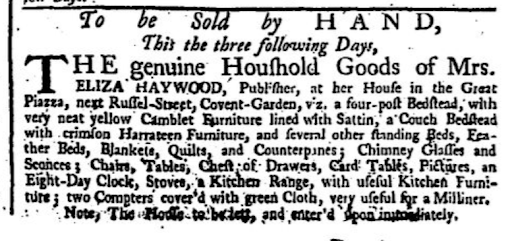
Figure 7. Advertisement detailing the sale of the “genuine household goods of Mrs. Eliza Haywood” from the London Daily Advertiser for April 4, 1744. Burney Newspapers Collection. Gale Document No. Z2000149544.
This specific address, King observes, would have received “a great deal of foot traffic, which may explain why Haywood did not advertise her wares heavily in the papers during the years she operated the shop at Fame” (103). It is also important to note that this five year period likely does not encompass all of Haywood’s work as a firm, but her corner shop at the Sign of Fame is the only address that modern scholars have specific knowledge of. As King points out, why else would Haywood identify herself as “Eliza Haywood, Publisher” in the above advertisement if not to “keep that line of work open” to her in future (A Political Biography 109).
|
Tip! Want to see every address a printer, publisher, or bookseller worked out of? For female-run firms with multiple known addresses, the WPHP records each one separately and links them under the “Related Firms” field within a woman’s person record. |
King’s A Political Biography also alerted us to a unique broadside from 1742—The Ghost of Eustace Budgel Esq. to the Man in Blue—that named Haywood in its imprint. Locating a digitization of this broadside posed some difficulties; as is often typical of more ephemeral forms of print, none of the bibliographic or archival sources we usually rely on had any record of The Ghost. Eventually, we located a photograph of this broadside posted on the Yale University library’s Recent Antiquarian Acquisitions blog. As the WPHP records the price of a title when known, users of the database may observe that this broadside—priced at one shilling—was expensive for the time period. This type of data around price helps users of the WPHP make inferences about the quality of an item or the social status of its intended audience.
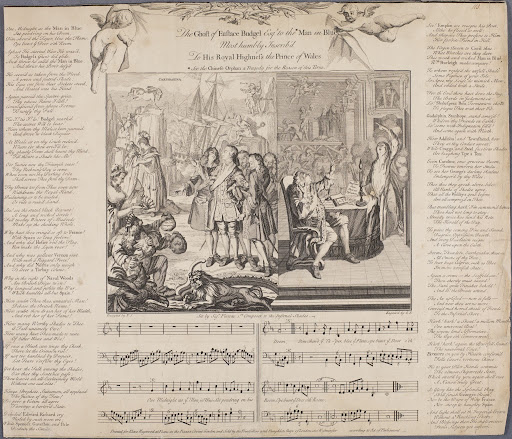
Figure 8. Photograph of the broadside, The Ghost of Eustace Budgel from the Recent Antiquarian Acquisitions blog hosted by Yale University’s Lewis Walpole Library.
The imprint for this broadside appears at the bottom of the page in small font, reading “Printed for Eliza Haywood at Fame in the Piazza Covent Garden.” Of the ten titles we have been able to confirm Haywood’s involvement in as a firm, four of these titles categorize Haywood’s labour using this same language in the imprint. As we discussed earlier in the section on terminology, the use of “printed for” in an imprint typically indicates the publisher of a title. However, prior to the late eighteenth century, the language delineating publishers and booksellers—and the boundaries of their respective responsibilities in a text’s production—was very much in flux. Kate Ozment’s spotlight, “What Does it Mean to Publish?,” recognizes the “slipperiness of imprints” through the mid-eighteenth century and offers us some helpful distinctions to keep in mind as we consider how best to define Haywood’s work in the book trades. As Kate Ozment’s table on “Early Eighteenth-Century Associations” affirms, “publisher” and “bookseller” had not yet solidified into distinct, consistently defined roles during Haywood’s time at the Sign of Fame in the 1740s.
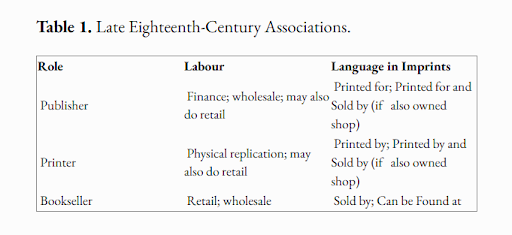
Figure 9. A table describing later eighteenth-century distinctions between publishers, printers, and booksellers from Kate Ozment’s “What Does it Mean to Publish?”
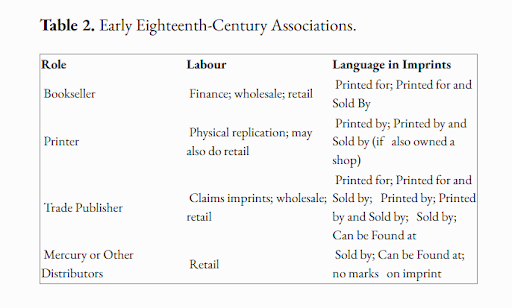
Figure 10. A table noting earlier eighteenth-century distinctions between different types of firms from “What Does it Mean to Publish?”
For the sake of consistency across the database, the WPHP relies on the language in a title’s imprint to catalog each individual's role in its publication and sale. Herein, Haywood’s firm record is attached to six titles as a “bookseller” and four as a “publisher.” Importantly, this data does not mean that Haywood was simultaneously a bookseller and publisher as we understand these roles today. The seeming contradiction here emphasizes the mutability of the data the WPHP navigates to parse early eighteenth-century imprints (not to mention colophons) into our data fields. Considering both the primary and secondary research our team conducted, what we can be certain of is that Haywood’s shop sold a variety of books, pamphlets, and broadsheets. This retail activity marks her as a bookseller by both early and late eighteenth-century conceptions.
Understanding more about the nature of Haywood’s business at her Fame address also prompts us to ask why Haywood chose to name herself as “Eliza Haywood, Publisher” in her 1744 advertisement for the sale of her household items (figure 6). In A Political Biography, Kathryn King writes that while Haywood “did do some publishing (in the modern sense),” it was “in a small way, six-penny tracts, broadsides, and the like” (97). With the “single exception of The Virtuous Villager,” King asserts that Haywood “never published a substantial, book-length work” (97). Discussing this exception, King also reminds us that there was additional complexity at work behind the scenes of an imprint and argues that this title may not have been wholly or directly published by Haywood. According to King, Haywood translated The Virtuous Villager for bookseller Francis Cogan (with whom she had a long working relationship), thereby leading Cogan to “pa[y] [Haywood] with stock in…[The Virtuous Villager] and possibly a part share in the copyright” (97). Observing that Haywood’s name only appears in the imprint of the second volume of the 1742 edition of The Virtuous Villager—though she is given a page at the end of the first volume to advertise two new books available at her shop—lends further credence to King’s reading of their working relationship. King’s interpretation emphasizes that Haywood’s work as a “publisher” was more in the vein of an early eighteenth-century trade publisher (see figure 10) than a publisher we would recognize in the late eighteenth century or even today (see figure 9). Nonetheless, we should not ignore that Haywood elected to call herself a publisher in her advertisements to the public. If we can acknowledge that trying to determine the nuances of Haywood’s labour in the book trades two centuries later leaves modern readers to tread in muddy waters, we can also recognize that Haywood’s own descriptions for herself should hold considerable import in our understanding of her career.
Recommendations for Further Reading & Listening
In this guide, we have explored how the data collected in the WPHP’s firm records can broaden our understanding of the careers of lesser-known female publishers, booksellers, and printers. If you are eager to continue your deep dive into the long eighteenth-century book trades, take a look at these recommendations for additional reading and listening.
If you prefer to listen to your book history content, check out our podcast, The WPHP Monthly Mercury, led by project manager Kate Moffatt and lead editor Dr. Kandice Sharren. You can find each episode on Apple, Spotify, Stitcher, Google Podcasts, and other podcast apps.
For more on the complexity of tracking and cataloguing woman-run firms, tune in to Season 4 Episode 3 “Address-ing Firms” where Kate and Kandice consider what it means to embody the labour of book history scholarship.
To learn more about what can only be described as a New Romanticisms extravaganza, listen to Season 4 Episode 1 “‘It's (A)Live!’ The WPHP Monthly Mercury at New Romanticisms” where Kate and Kandice interview a variety of scholars in attendance at the 2022 “New Romanticisms” conference hosted by BARS and NASSR.
To hear more about some of the understudied women represented in the WPHP, tune in to Season 3 Episode 3 “Working for the (Wo)man” to explore some of the research rabbit holes the team pursues. For further information about the women cited in this episode, read about the Farley family, Agnes Campbell, Jane Aitken, and Ann Vernor in the “Down the Rabbit Hole: Researching Women in the Book Trades Spotlight Series.”
For more on the context and rationale behind the WPHP’s data model, check out the “By Our Books: Bibliography in the WPHP” spotlight series to learn about the fields in our title records. Whether you’re more intrigued by Titles, Format, or Editions, there’s a spotlight for everyone in this series.
And, finally, if you’re curious about the past and future of the WPHP, listen to Season 5 Episode 5 of the Monthly Mercury, “Finding, Building, Sustaining, Supporting,” featuring book history scholars Isobel Grundy, Leslie Howsam, and Maureen Bell.
WPHP Records Referenced
Alice Reilly (firm)
The principles of the Christian religion explained (title)
A proposal for erecting granaries in the City of Dublin (title)
“What Does it Mean to Publish? A Messy Accounting of Anne Dodd” (spotlight by Kate Ozment)
“Address-ing Firms; or, The Consequences of Our Own Actions” (podcast episode)
Eliza Haywood (person)
A Bibliography of Eliza Haywood (database source)
Eliza Haywood (firm)
“Down the Rabbit Hole: Researching Women in the Book Trades Spotlight Series” (spotlight series introduction)
Mary Lawrance (firm)
The Virtuous Villager (title)
A Remarkable Cause (title)
The Right Honourable Sir Robert Walpole (title)
The Ghost of Eustace Budgel Esq. to the Man in Blue (title)
Colophons Count (spotlight by Kate Moffatt)
Works Cited
“Advertisements and Notices.” Daily Advertiser, 4 Apr. 1744. Seventeenth and Eighteenth Century Burney Newspapers Collection, link-gale-com.proxy.lib.sfu.ca/apps/doc/ Z2000149546/BBCN?u=sfu_z39&sid=bookmark-BBCN&pg=3&xid=ea1f0c14. Accessed 20 Mar. 2026.
“Advertisements and Notices.” Daily Advertiser, 13 Jan. 1744. Seventeenth and Eighteenth Century Burney Newspapers Collection, link-gale-com.proxy.lib.sfu.ca/apps/doc/ Z2000149182/BBCN?u=sfu_z39&sid=bookmark-BBCN&pg=5&xid=f7ac6b6c. Accessed 20 Mar. 2026.
George, Vertue. Eliza Haywood. Wikimedia Commons, https://commons.wikimedia.org/ wiki/File:Eliza_Haywood,_PA08101.jpg. Accessed 20 Mar. 2026.
King, Kathryn R. A Political Biography of Eliza Haywood. Pickering & Chatto, 2012, https://www.taylorfrancis.com/books/9781315653013.
Ozment, Kate. “Women’s Labor in the Mid-Eighteenth-Century English Literary Economy.” Huntington Library Quarterly, vol. 84, no. 1, 2021, pp. 87–98. JSTOR, https://www.jstor.org/stable/27240375.
Parr, R. Frontispiece to The Female Spectator by Eliza Haywood. 1746, Houghton Library, Harvard University. Wikimedia Commons, https://commons.wikimedia.org/ wiki/File:Houghton_EC7.H3362.746f_-_Female_Spectator.jpg.
“The Ghost of Eustace Budgel Esqr. to the Man in Blue.” Recent Antiquarian Acquisitions, The Lewis Walpole Library, Yale University, https://campuspress.yale.edu/lewiswalpole/the-ghost-of-eustace-budgel-esqr-to-the-man-in-blue/. Accessed 20 Mar. 2026.